

Ready to build better conversations?
Simple to set up. Easy to use. Powerful integrations.
Get free accessReady to build better conversations?
Simple to set up. Easy to use. Powerful integrations.
Get free accessFor a decade, Aircall has connected businesses to the tools their teams run on. Today, that same ecosystem opens to AI, giving partners and developers a public, documented path to build voice and messaging agents and to connect their own systems to Aircall's AI.
The next advantage is a more connected AI
The next competitive advantage in sales and customer service isn't a better AI model, it's a more connected one. Most teams think they have an AI problem, but they don’t; they have a connection problem. Their AI stops at the edge of the conversation because it has nowhere to go.
A decade ago, Aircall built an ecosystem to connect customer conversations to the tools a team runs on: CRMs, helpdesks, and e-commerce platforms. Today, that ecosystem links 23,000 businesses through more than 250 integrations, built on one belief: connected tools outperform isolated ones. That ecosystem is now open to AI.
The integration era was built for people
Aircall's 250+ integrations were designed around a single assumption: that a person sits at the center of every conversation, reading the data and deciding the next step. Those integrations log calls, sync contacts, and update records after every conversation. They work, and they run in production across tens of thousands of businesses today.
AI changes the requirement. AI agents now handle a growing share of customer conversations, and every conversation produces something new: structured intelligence such as summaries, sentiment, and action items, generated automatically and at scale. That intelligence is valuable only if it reaches the rest of your stack. And an AI agent needs more than intelligence. It needs to act; look up an order, update a record, or book a meeting mid-conversation, without a handoff. That calls for a new kind of integration, one built for AI rather than for human teams alone.
Aircall: The most integrated AI platform
Aircall is opening its AI ecosystem to partners and developers, so its AI agents become the most connected customer communication agents in the market. Until now, the intelligence Aircall generated from every call flowed only to a handful of selected partners, and its agents could act only inside a fixed set of tools. Three releases change that.
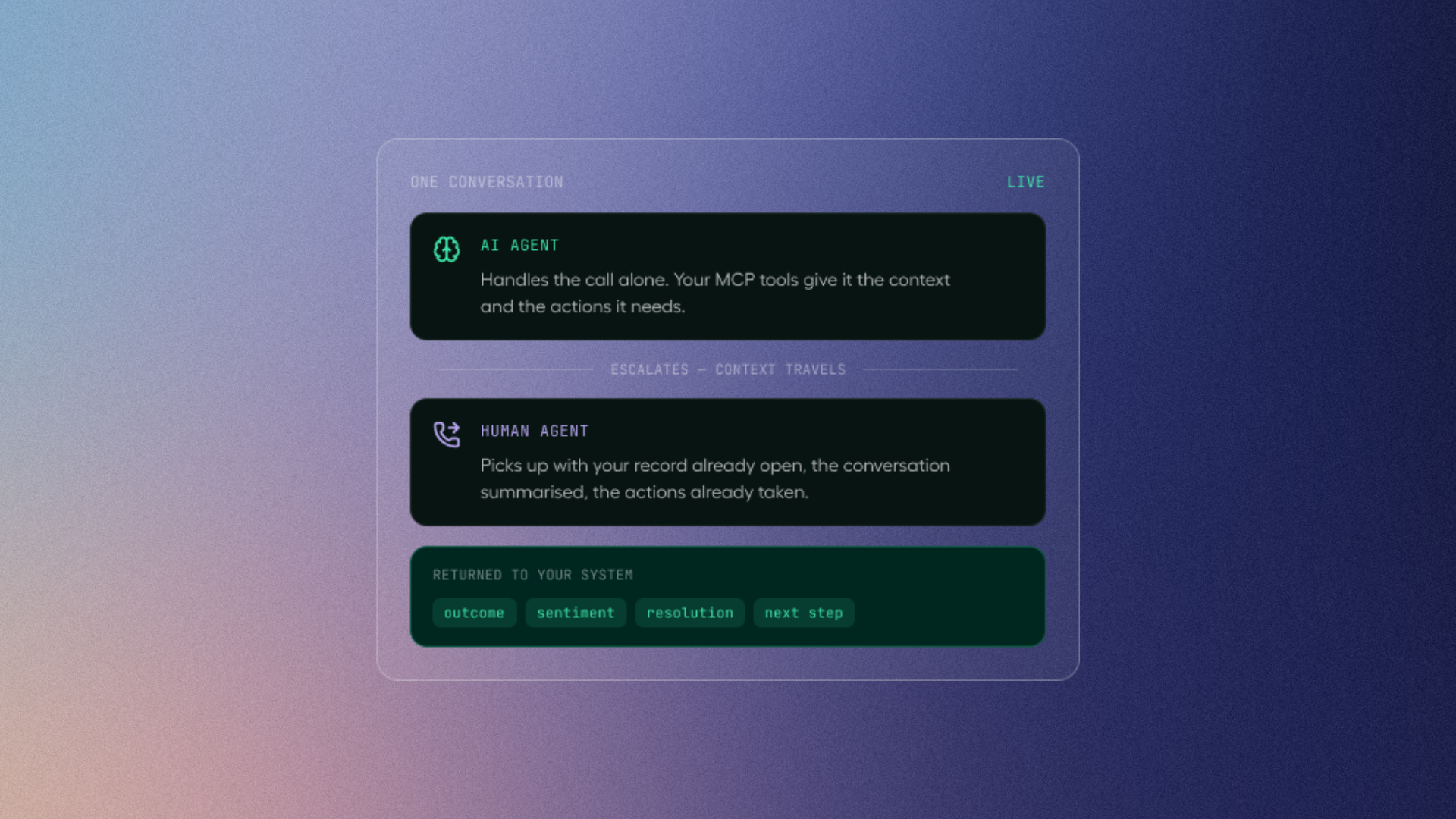
AI Actions, live today, lets Aircall's AI agents connect to and act within external tools over MCP, including Shopify, HubSpot, and Zendesk. The Developer Portal is the public, documented entry point to the ecosystem, engineered so that building on Aircall is faster and easier. Partner MCP Registration lets external partners register their own MCP servers, so their tools surface as available AI Actions inside Aircall.
Three products are now openly buildable:
AI Assist turns every call and message into structured intelligence, available through REST APIs and webhooks.
AI Voice Agents run calls end to end, follow workflows, and take actions in connected systems.
AI Messaging Agents bring the same capabilities to SMS and WhatsApp.
The connective layer is MCP, the emerging standard that lets AI agents discover and use external tools. The mechanics are deliberately simple: share an MCP URL, keep your schemas and descriptions clean, and Aircall's agents discover your tools automatically.
Connect a system once, and every Aircall AI product can use it, that’s what makes Aircall the most integrated AI platform.
What a connected agent can do
Generic AI responds, but truly connected AI resolves. So, when an Aircall agent reads and acts across several systems at once, it stops being a responder and starts doing a job.
A retail business can configure an Order Concierge that pulls order details from Shopify, processes a refund through Stripe, and logs the outcome in your CRM, all inside a single call. A sales team can run a Lead Qualifier that answers inbound, qualifies the lead, enriches the record in HubSpot, and books a meeting in Calendly before the caller hangs up. The role is yours to define, and the more systems you connect, the more complete the job your agent can do.
Built on infrastructure that already works
This isn’t a rebuild; it’s a new AI layer on the same ecosystem Aircall has operated for ten years. The tools your team uses today, such as HubSpot, Shopify, and Zendesk, become accessible to your AI agents in a fundamentally different way; not just receiving data after a call, but being acted on during one. Your stack becomes AI-ready at every opportunity.
Open by default, and compounding
Attio, HelpScout, Front, HubSpot, and Calendly are the first partners to go live in the ecosystem. Attio, the AI-native CRM, is the first MCP-native CRM connected to AI Voice Agents at launch. Later this summer, any partner will be able to self-register their MCP and join them.
But the beauty is, that design compounds. Every partner that connects adds a capability every Aircall customer's agent can use, automatically, without the customer doing anything. Connect once, and reach every Aircall customer from day one. For customers, the shift is just as direct: technical teams can sync AI Assist outputs into any internal system, trigger AI Voice Agents and AI Messaging Agents from their own workflows, and build their own integrations to CRMs, helpdesks, and data warehouses, without filing a support ticket.
Why now?
The market is deciding which communication and CX tools will emerge as genuinely AI-native platforms rather than tools with AI bolted on. Opening the ecosystem is how we answer that question; not by adding more features, but by becoming the infrastructure that AI voice and messaging agents are built on and connected to.
For ten years, Aircall has connected human agents to the tools they need. The same ecosystem now does it for AI agents, and it’s open to everyone who wants to build.
Start building on the Aircall Developer Portal with AI Assist, AI Voice Agents, and AI Messaging Agents, or register your MCP to connect your tools to Aircall's AI agents.
Published on September 1, 2026.
